
CLINICAL SUPERVISION

Clinical supervision at Knots Counseling is designed for therapists seeking a thoughtful, clinically grounded space to deepen their work, strengthen their professional identity, and feel more supported in the complexity of practice. Therapists often seek supervision when they want to better understand their clients, reflect on countertransference, develop clinical judgment, work through stuck points, or feel less alone with the emotional weight of the work.
At Knots, clinical supervision is not only approached as a formulaic review of cases or a purely administrative requirement. The work is shaped around the clinician’s developmental stage, theoretical orientation, client population, clinical questions, and professional goals. Our approach is grounded in psychodynamic understanding and informed by integrative clinical practice, meaning that we pay attention to both the clinical material and the therapist’s experience of the work.
Clinical supervision is a space to understand not only what is happening with the client, but what is happening in the room, in the therapeutic relationship, and within the clinician as the work unfolds.
SUPERVISION FOR THERAPISTS SEEKING TO DEEPEN CLINICAL THINKING, UNDERSTAND CASE COMPLEXITY, AND DEVELOP A MORE CONFIDENT PROFESSIONAL IDENTITY.

Seeking a reflective space to discuss client cases with greater clinical depth.
Feeling stuck, uncertain, overwhelmed, or emotionally activated in your work with a client.
Wanting to better understand transference, countertransference, defenses, resistance, enactments, and relational patterns in therapy.
Developing your psychodynamic or integrative clinical voice.
Navigating questions around diagnosis, treatment planning, case formulation, boundaries, ethics, or therapeutic frame.
Working with clients around anxiety, depression, trauma histories, identity, relationships, multicultural concerns, life transitions, or complex family dynamics.
Noticing your own emotional responses, doubts, avoidance, urgency, frustration, protectiveness, or uncertainty in the clinical relationship.
Seeking support with private practice development, clinical confidence, professional identity, and the transition from trainee or early-career therapist into more independent clinical work.
Looking for supervision that goes beyond “what should I do?” and helps you understand why the clinical situation feels complex.
CLINICAL SUPERVISION MAY HELP IF YOU ARE
HOW WE APPROACH THE SUPERVISORY WORK

Our work begins with careful listening and clinical formulation. Rather than treating supervision as a space for quick answers only, we try to understand the clinical situation in context.
A client’s symptoms may not only be symptoms. They may be connected to defenses, attachment patterns, relational histories, internal conflicts, cultural meanings, trauma, grief, shame, or unspoken needs.
A stuck point in therapy may not only be a technique issue. It may reflect something happening in the therapeutic relationship, a defensive pattern, a rupture, an enactment, a countertransference response, or uncertainty about the treatment frame.
A therapist’s emotional reaction may not be something to dismiss or hide. It may contain important clinical information about the client, the relationship, and the therapist’s own internal experience.
This is where psychodynamic supervision becomes especially useful. We pay attention to unconscious processes, relational dynamics, defenses, affect, meaning, and the therapist’s use of self. At the same time, supervision remains practical and clinically responsive. When useful, we may integrate discussion of interventions, treatment goals, diagnosis, psychoeducation, boundary-setting, risk assessment, documentation, and the structure of care.
The goal is not only to understand the case, but to help you think more clearly, intervene more intentionally, and feel more grounded in your clinical role.
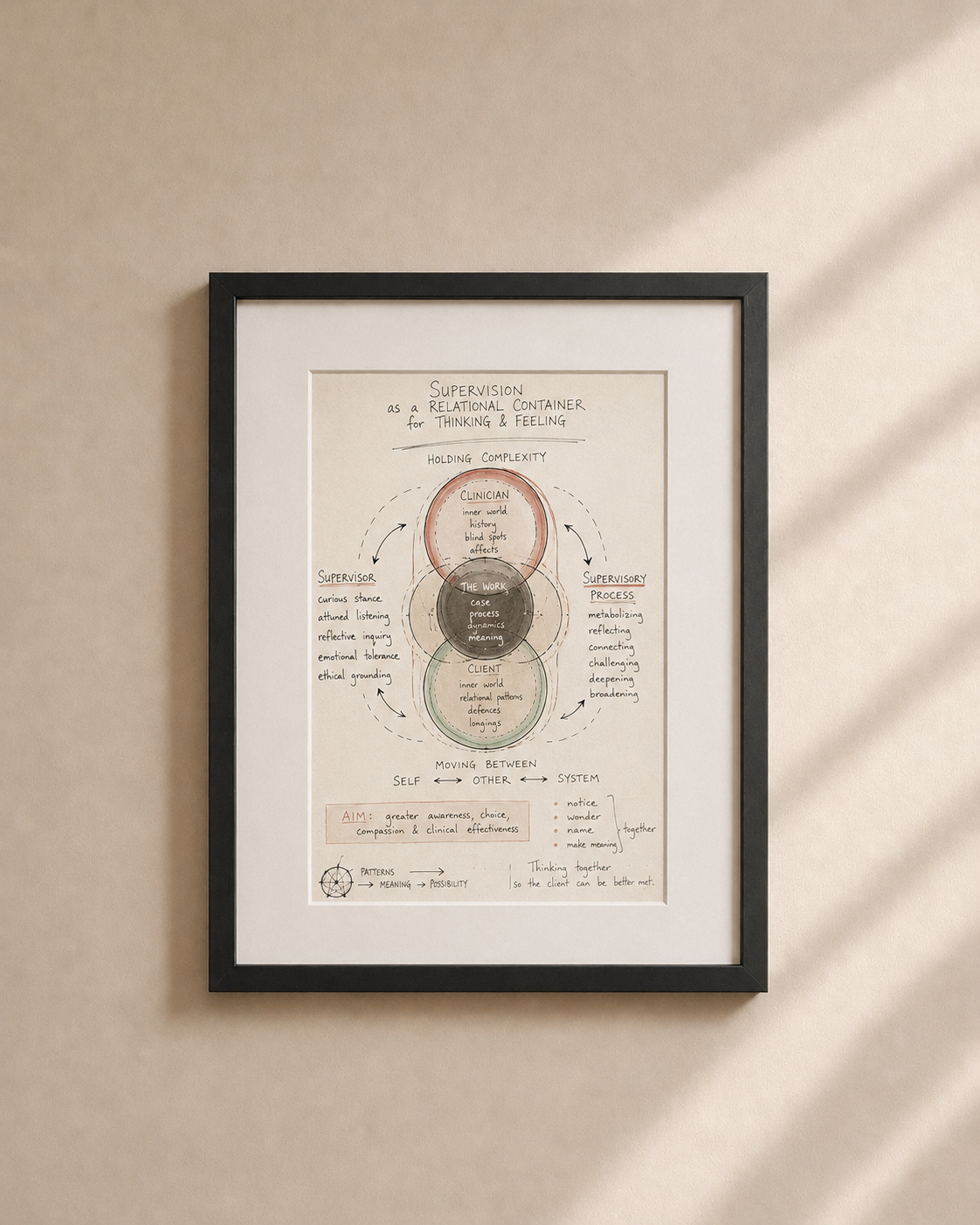
HOW SESSIONS OFTEN LOOK LIKE
Supervision sessions are conversational, collaborative, and clinically focused. You may bring in a client case, a difficult session, a moment of uncertainty, a countertransference reaction, an ethical question, a diagnostic concern, or a recurring clinical pattern you are beginning to notice.
Together, we may slow down the clinical material and ask:
What is the client communicating directly and indirectly?
What emotional themes keep returning in the work?
What defenses, conflicts, attachment patterns, or relational dynamics may be present?
What is happening in the therapeutic relationship?
What did you feel, notice, avoid, or feel pulled to do as the therapist?
What might the client be repeating with you that has occurred in other relationships?
What clinical intervention may be most appropriate at this stage of treatment?
How can you remain attuned, ethical, boundaried, and clinically effective without losing your own grounding?
This process helps supervision move beyond advice-giving or case reporting. While it can be helpful to discuss what to say or do next, the purpose of supervision is also to strengthen your capacity for formulation, reflection, timing, intervention, and clinical judgment.
HOW SUPERVISION CAN HELP

In clinical supervision, we may work on:
Developing psychodynamic and integrative case formulations.
Understanding transference, countertransference, enactments, defenses, resistance, and relational patterns.
Identifying emotional themes and unconscious conflicts in the clinical material.
Strengthening clinical judgment around interventions, timing, pacing, and treatment focus.
Exploring the therapist’s use of self and emotional responses in the work.
Thinking through diagnosis, treatment planning, risk, documentation, boundaries, and ethical considerations.
Supporting work with multicultural identity, migration, family systems, language, belonging, and cross-cultural dynamics.
Developing greater confidence in clinical decision-making and professional identity.
Clarifying how to work with clients who feel stuck, guarded, highly intellectualized, emotionally avoidant, crisis-driven, or relationally complex.
Connecting clinical insight to more effective therapeutic action.
The positive effects of supervision often extend beyond a single case. As the work develops, therapists may feel more grounded in the room, more able to tolerate complexity, and better equipped to understand what is happening beneath a client’s symptoms, stories, and relational patterns. Supervision can help clinicians move from uncertainty or reactivity toward clearer formulation, stronger intervention, and a more integrated sense of themselves as therapists.
This process helps supervision move beyond simply asking for advice or reassurance. While guidance is often part of the work, the deeper purpose of supervision is to strengthen your ability to think clinically, use yourself thoughtfully, and intervene with greater confidence and precision. When you begin to understand why certain clinical patterns keep returning, it becomes more possible to work with them rather than feel caught inside them.
Over time, cases that once felt confusing can become more coherent. Emotional reactions that once felt distracting can become clinically meaningful. Interventions can become more intentional. Boundaries can feel clearer. Your professional voice can become more grounded, flexible, and distinct.
Clinical supervision does not offer a script for every clinical situation. Instead, it offers a careful and purposeful process for understanding the knots underneath client material, therapeutic relationships, and the clinician’s own development so that your work can become more thoughtful, ethical, and effective.
Clinical supervision can help make complex therapeutic processes more visible. For example, you may begin to notice how a client’s withdrawal affects your own sense of urgency, how a client’s idealization creates pressure to perform, how chronic crisis pulls you away from formulation, or how a client’s self-criticism begins to shape the emotional atmosphere of the work.
These clinical moments often carry meaning. They may reflect transference, countertransference, enactments, defenses, attachment expectations, cultural dynamics, or the client’s difficulty putting certain experiences into words. In supervision, we work to understand these moments carefully so they can become clinically useful rather than confusing, overwhelming, or acted out.
As the clinical picture becomes clearer, intervention becomes more thoughtful. You may begin to recognize when to interpret, when to support, when to clarify, when to slow down, when to address the frame, when to name a pattern, when to explore affect, and when to prioritize stabilization, safety, or practical coping. Supervision can help you develop not only more confidence, but also better clinical timing.